

Home schooling at school
Masterclasses are tutored, not taught. They tailor principles and techniques of the Oxford tutorial & Cambridge supervision systems to benefit teenagers facing exams.
Students learn to think like a scholar in their subjects whilst building the knowledge & technical expertise to demonstrate it in exams.
- Knowledge of subject content
- Command of terminology
- Technical ability
- Mastery through practice
- Worked solutions
- Model answers
- Socratic questioning
- Preparation, not homework
- Small face-to-face groups
- Adaptive lessons
Tutoring is responsive, whereas teaching is often necessarily prescriptive.
Large classes tend to move through topics in an order and at a pace dictated by the exam board. Schedules ensure every topic has been ‘covered’ – taught, not necessarily learnt.
Masterclasses are distinct by design: the structuring principle of the course is the students themselves.
- The tutor’s expertise is deployed on demand
- Knowledge is co-constructed rather than imposed
- Each class emerges organically from dialogue
The approach is deliberately adaptive yet rigorously bound to the syllabus content to ensure exam success. Students at times work together on a shared topic; at others they may pursue entirely independent paths. Time is spent on what is most relevant to individual progress.
- Think-aloud protocols and Socratic questioning encourage students to prove their ability and justify their decisions
- Worked examples, model answers and students’ own solutions are compared and dissected
- Mastery practice makes problem-solving instinctive and refines technique in preparation for exams
- ‘Preparation before’ class instead of ‘homework afterwards’ cultivates agency, accountability and confidence
- Students become well practised in ‘performing their knowledge’ under exam-like conditions
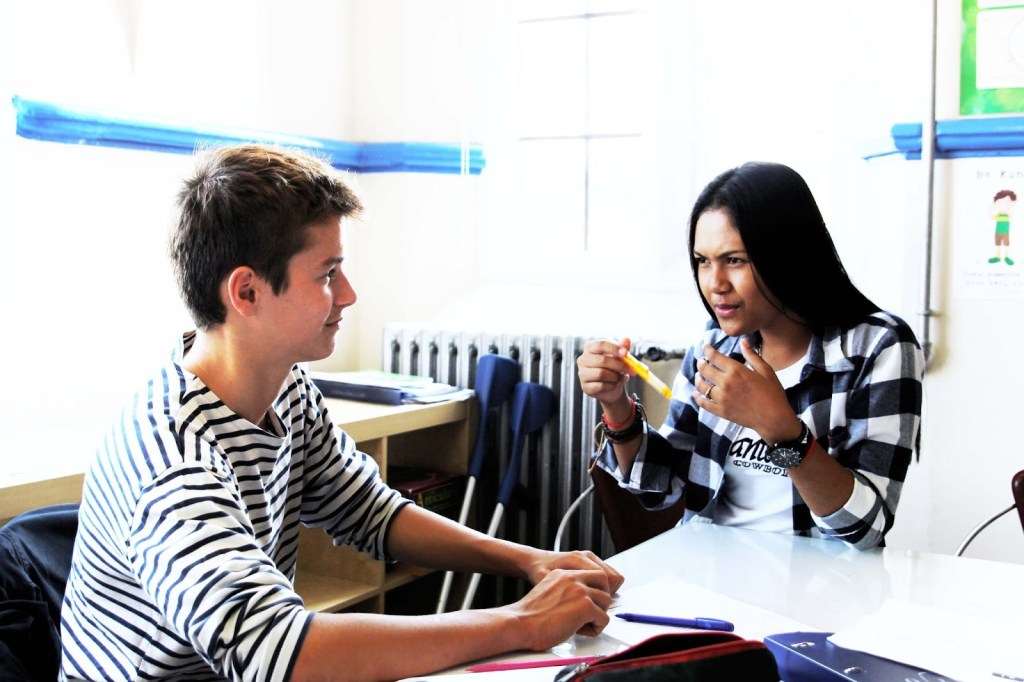
Face-to-face learning
Technology serves certain aspects of learning well. In contrast to big-screen, online or AI learning, however, a masterclass is a decidedly human environment.
To gain and maintain motivation, teenagers typically need to know their efforts will be witnessed in real life. That cannot be properly achieved remotely through a computer screen.
In some classrooms, students may resemble an audience – passive, expecting to be taught. But a good learning environment is more akin to an intelligent, challenging discussion around the dinner table or by the fire side.
Format
At the end of each masterclass, tutors assign preparatory tasks. The next session begins by exploring understanding, clarifying concepts and addressing misconceptions – before moving on to new topics.
Within each lesson, students may look in depth at a specific trickier topic or be introduced to several. The aim is mastery of all topics, and tutors choose resources, activities and methods for their efficiency towards that end.
Conversations follow a diagnostic rhythm. The tutor questions, the student explains, and gaps reveal themselves naturally. Understanding deepens through challenge rather than lecture.
To get their homework done, students learn to be increasingly disciplined with their routines and efficient with their techniques. Homework isn’t busywork to be checked off – it is preparation for an intellectual performance. This transforms the student-homework relationship from an obligation into a rehearsal.
Homework instructions are not framed broadly as, ‘Study chapter 4,’ etc. They are presented as a list of research questions obliging students to both read and interpret resources before discussing them in the following session. This naturally covers syllabus content as well as engaging deeper faculties.
Memory & recall
Getting knowledge into memory is a tiny part of learning and can be done alone. Getting knowledge back out differentiates exam success from failure.
The brain gets better at whatever it does repeatedly, but only the very specific task it repeats. If a student reads a course book or revision guide over and over again, they will become highly proficient at reading that book and not much else. If they sit passively in front of videos or in classrooms, they will get good at only that. But if they read (or listen or watch) and practise recalling what they have read, then they will get better at recalling. In this sense, testing (recalling) is learning.
Tutored testing is powerful, just like a parent can have an impressive effect by testing their child on a list of words or their times tables. Masterclass students repeatedly practise facing the ‘exam’ in the form of a tutor who is sympathetic, encouraging and knows the best questions to ask.

Knowledge precedes understanding
“I just don’t get it, so I can’t learn it!” is an unfortunate frustration voiced by unsuccessful students. They think they should understand something before learning it. But knowledge must come first so that understanding can follow. Successful students learn almost blindly, gathering knowledge and practising until they understand.
When it comes to school subjects, ‘knowledge’ is sometimes little more than complicated terminology for relatively straightforward things. That is why course books have glossaries, and why the definitions in them can be short. Successful students have often memorised the glossary, if not the entire course book, and can therefore articulate their knowledge properly.
Enjoying Learning
‘If children enjoy lessons, they’ll learn more’ is, unfortunately, not true beyond primary school. The reverse is true at secondary level: students who learn more and perform better academically enjoy school more.
The solution to enjoying learning is to learn more.
Entertaining lessons, interactive technology, ‘fun’ activities, edu-apps, visiting speakers, and school trips all attempt to make learning enjoyable – a worthy aspiration. But while these methods may engage students, they don’t by themselves improve grades. The reasoning is backwards.
In general, people enjoy doing what they do well. Students don’t learn more simply because lessons are fun. Rather, they enjoy a subject when they’re good at it. The better they become at it, the more they’ll enjoy school and perhaps even exams.
The path to enjoying learning runs through competence, not entertainment.

 Newbury Study Hall